.jpeg)
Introduction
For my Balkan project, I decided to learn about the differences in Balkan food because I like cooking food, eating food, and trying new foods. How this all started was when I was bored in Moshi, and decided to look at my mom’s cookbook. I made peanut-butter cookies, and wanted to cook a lot more. When we were trying to figure out what we wanted to research in the Balkans, I was wondering what makes different dishes special in different Balkan countries. I focused on burek, a pastry with a savory filling inside, cevapi, a grilled meat cooked over hot coals, and moussaka, a casserole-type dish. To my surprise, I learnt that there aren't that many differences between the different Balkan countries' food. However, I learnt that by looking into the history behind the food, you learn about the subtle differences in the dishes.
.jpeg)
.jpeg)
.jpeg)
Background
Did you know that it is rude for food to be left on a plate in the Balkans? That shows how much the Balkans care about food (Gostina). Before we get into further detail, you probably need to learn about the history behind the food in the Balkans. Meat and vegetables have always been part of the culture, for the Thracians had a long culture around meat, and the Slavs brought agriculture and vegetables. There are not so many spicy spices, because, according to Thomas Moore Devlin, the Balkans like to emphasize meat and vegetables (Delvin). The spices that they use are a lot of savory, a mix of spices like oregano, and paprika, ground up red pepper (Robert). The main vegetable bases are tomatoes and potatoes, which I find interesting, for potatoes only came to the Balkans in the 19th century, because of the Colombian exchange. The Ottomans also had a big influence on Balkan food. They brought red peppers, which is a key ingredient in all Balkan food (Gostina). They also were Muslim, which means that they did not eat pork. When they conquered the Balkans in the 14th and 15th centuries, they spread their religion around, so now in some countries like Bulgaria, they do not use pork as a big ingredient (Viking).
.jpeg)
.jpeg)
Methodology
To learn all of this information about Balkan food, I had to interview Robert from Bulgaria, who kindly organized a cooking class for us in his restaurant. I interviewed the baker from Pekara Stari Most, where we got burek in Mostar, and the cooking class in Mostar. I read and watched 21 articles and videos, and ate a LOT of food. I also made cevapi in Montenegro, moussaka in Bulgaria, and burek in Bosnia.
.jpeg)
.jpeg)
.jpeg)
Section One: Moussaka
The first dish that I studied was moussaka. Moussaka consists of potatoes, tomatoes, ground beef, paprika, and other ingredients. It is basically a casserole with a cheese topping. There are only subtle differences in different countries. In Turkey, it is not layered, and they use lamb. In Bulgaria, since they are mostly Eastern Orthodox, they use pork and beef. In Greece, they use eggplants. The Bulgarian version, the one I made, consists of eggs, cheese, potatoes, and sometimes spinach. In Romania, it is the national dish, sometimes they even put noodles in it (Cooks Without Borders).
.jpeg)
.jpeg)
There are many different types of moussaka, originating from different cultures. The Bulgarians have some origins from the Thracians, which are 55% of the “genetic landscape”, early Slavs, which are 40%, and Bulgars, which are 2.3% (Wikipedia). According to the Youtube channel, History with Dr. Tam, “the Bulgars originated from the Turkic nomadic warrior tribe that came from the Pontic-Caspian steppe, and arrived to the Volga and Danube during the 5th-7th century.” Britannica says that “the Bulgars were derived from a Turkic tribe of Central Asia (perhaps with Iranian elements)”. The main idea is that they are a mix of cultures. The southern Slavs come from modern-day Poland, Ukraine, and Belarus. They started attacking the Byzantines, and yet, the Byzantines still hired some Slavs as mercenaries. The Slavs started crossing the Danube at the same time as the Bulgars, the 5th to 7th century. At this time, they also even attacked Constantinople! They intermarried with Bulgarians, Serbs, Croats, and others. They went from being tribes to being kingdoms. That shows us the background of moussaka.
The Greeks are way older than the Bulgars, and they have the most differences in their moussaka. The Greek language originated from 34 centuries ago, so roughly in 1400 BCE. The earliest form of Greek was Mycenaean Greek. The reason why the Greek version has eggplant is because in Greece, it is warm weather, and that is the climate that eggplants grow in. The reason why this all connects to language is because when you read a recipe, you read it in your own language, so it also comes with some nationalism. According to John Shea, the Greeks see themselves as "homogeneous", unlike the Bulgarians. In 1920, Greek Nicholas Tselementes, wrote a cookbook about Greek food, and made moussaka based on a French recipe. The way he made it is usually the way we make it now, so that shows how diverse the food is (One Dish Closer to Perfection). This shows us that even though moussaka has subtle differences, it intertwines with bigger issues of nationalism.
 |
| Nicholas Tselementes |
Section Two: Burek
One of the most famous Balkan dishes is burek. Burek is a round pastry with many different fillings, but the most common ones are either cheese, spinach, meat with onions, or sometimes even pumpkin. According to Srdjan Garcevic, an author of the article I read, burek comes from all over, and each Balkan country thinks it's their own (Garcevic). Serbian burek has pork, while in Bosnia and Herzegovina, they don’t use pork, for they are mostly Muslim. Burek can either be eaten hot or cold, but I prefer it hot. When I first tasted burek in Niš, Seria, I thought it tasted very flakey and delicious, and couldn't eat enough of it! In the cooking class in Mostar, the teacher said that since they don’t use pork, it does not stick together as well, so they use a rolling pin. To make the pastry really thin and flakey, you had to flip it on the rolling pin. I flipped mine too slowly, so it fell on the ground! In Bosnia and Herzegovina, they say that the word burek only refers to meat, while other fillings are called pie. The teacher at the cooking class in Mostar also said that to get permission to marry, the wife had to cook burek in front of her mother-in-law, to see if she was eligible (Mostar cooking class).
.jpeg)
.jpeg)
.jpeg)
Burek has a lot to do with the Ottomans.The name burek comes from the Turkish word bur, which means "to twist" or "bend". This refers to the method of turning the dough into a circle (Garcevic). In 1385, the Ottomans conquered Niš, in modern-day Serbia. According to Garcevic, in 1498 in Niš, the first modern version of burek was made. Bosnia managed to hold off the Ottomans until the Battle of Kljuc, in 1463. The Ottomans brought Muslim people to Bosnia, to spread Islam. People also converted for economic reasons, for you had a higher status if you were Muslim. That is how Bosnia became mostly Muslim (Viking). This shows how eating burek goes back to the Ottomans and their influence on Balkan religions. When I ate burek in Niš, Serbia, it was pork, while in Mostar, Bosnia & Herzegovina, it was beef.
.jpeg)
.jpeg)
Section Three: Cevapi
In my opinion, cevapi is one of the best Balkan dishes. It contains grilled meat shaped into four fingers in length, and put into bread with raw onions. The best way to cook it is over coals, a video said (DW Food). When we were in Mostar, my dad made my sisters and I eat at a cevapi restaurant. It was a crowded space, filled to the rim with tables and chairs. We managed to get a table, right by the kitchen. We ordered a five piece cevapi dish, which came with bread and the raw onions. It tasted very smokey, which proves that they were using a grill. My dad and I made cevapi, but it was hard because the grill was hanging from above, so it would swing when someone touched it! As I said before, in Bosnia and Herzegovina, they only use beef. That is the main difference between the different countries cevapi. The other difference is just the names, for in Bosnia it is called ćevapi, in Bulgaria it is called kebapche, and in Serbia it is called chevapchichi (DW Food). According to one article, cevapi is becoming common street food in the U.S.A, that shows how popular it is becoming (Balkan Bakery)! Like burek, so many countries want cevapi to be their own, Bosnia and Herzegovina even tried to get protected status, which means that they want to say that cevapi only comes from Bosnia and Herzegovina (DW Food).
.jpeg)
.jpeg)
.jpeg)
.jpeg)
.jpeg)
Cevapi comes from the Ottoman “kebab”, which refers to the Persian word meaning “to cook meat over an open fire”, which pretty much sums up cevapi. When I ate at a cevapi restaurant in Mostar, the cook said that in Bosnia and Herzegovina, they have more in common with the Ottomans than the other Balkan countries, for they are mostly Muslim. This goes back to the breakup of former Yugoslavia. After WW1, and the breakup of Austro-Hungarian and Ottoman rule, Yugoslavia was made. It consisted of kingdoms and regions, with Serbia, Montenegro, Macedonia, Bosnia and Herzegovina, Croatia, and Slovenia (Feature History). The breakup of Yugoslavia ultimately happened because of the death of Tito, the communist leader of Yugoslavia, for he did not allow the cultural tensions to rise. The death coincided with the economy dropping, and the cultural tensions rising in some certain regions, such as Croatia and Slovenia (WonderWhy). The war in Bosnia happened because in 1992, the Bosnians voted for independence, but the Bosnian Serbs did not want independence, so they declared war. Soon after, the Croats joined. By 1995, the war had resulted in 100,000 civilians killed, and over 2,000,000 people were forced to move (Remembering Srebrenica).
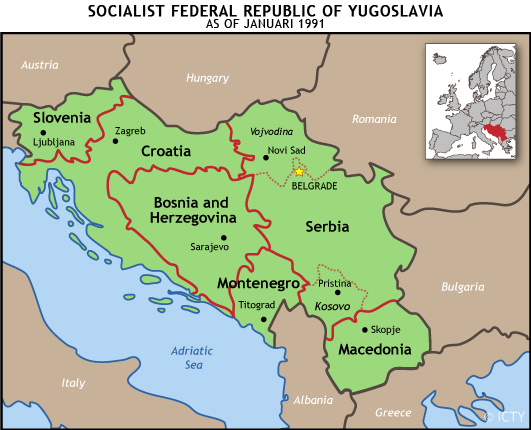

Ultimately, the combining of cultures created amazing food, but left a tragic war that killed innocent civilians. In Mostar, the place where I ate cevapi, there are 41% to 45% of Muslims, and in Bosnia and Herzegovina it is 51%. That shows why the man at the cevapi restaurant said that they connected more with the Ottomans, for it is because he is Muslim, and his ancestors converted to Islam because of the Ottomans conquering Bosnia.
Conclusion
For my conclusion, I made a three course meal. The appetizer was a mushroom soup, the main course was stuffed zucchinies, and the dessert was stuffed apples with lemon sauce. I learned from cooking that you get tired very easily. Time management is also very hard, because you have to plan out when the dishes are being made. Ironically, the Balkans do not have that many differences in their food, but have large political differences.
.jpeg)
.jpeg)
.jpeg)
.jpeg)
Works Cited
2nd Cevapi. Restaurant. 3 Mar. 2026.
Alina-Ioana Gostin, et al. Nutritional and Health Aspects of Food in the Balkans. 2026. London, Academic Press, 2021.
Babbel.com, et al. “Why Do Some Cultures Eat Spicy Foods and Others Don’t?” Babbel Magazine, 7 Sept. 2018, www.babbel.com/en/magazine/spicy-foods .
Balkan Bakery. “The Definitive Guide to Balkan Food (2025).” Balkan Bakery , 17 Sept. 2025, www.balkan-bakery.com/post/the-definitive-guide-to-balkan-food-2025 . Accessed 13 Mar. 2026.
Britannica Editors. “Bulgar | People | Britannica.” Www.britannica.com, www.britannica.com/topic/Bulgar.
BudgetTraveller. “Riding the White Horse: A Serbian Food Odyssey - BudgetTraveller %.” BudgetTraveller, 16 May 2021, budgettraveller.org/best-food-from-serbia/. Accessed 13 Mar. 2026.
“Ćevapi - Serbian National Dish.” Www.youtube.com, 13 Mar. 2026, www.youtube.com/shorts/rndiCR_Aacs. Accessed 13 Mar. 2026.
Cooking Class. Mostar. 13 Mar. 2026.
Costa, Luis. “The Origins of Greek: Language and History - Traductanet.” Traductanet, 24 Oct. 2024, traductanet.com/latest-news/the-origins-of-greek-language-and-history/.
DW Food. “How Different Types of Cevapcici Are Made in the Balkans.” YouTube, 10 Aug. 2024, www.youtube.com/watch?v=HVSc3TId3LE. Accessed 13 Mar. 2026.
History with Dr. Tam. “History of Bulgars.” YouTube, 2 Feb. 2024, www.youtube.com/watch?v=lZKbuIC3NU8. Accessed 18 Mar. 2026.
Kings and Generals. “How Did Bosnia Become Muslim?” YouTube, 27 Feb. 2025, www.youtube.com/watch?v=BsO5Auo8sCM. Accessed 30 Apr. 2025.
Lydiac. “The Soul of the Balkans: A Taste of Tradition and Togetherness – Exploringthebalkans.com.” Exploringthebalkans.com, Aug. 2025, www.exploringthebalkans.com/2025/08/01/the-soul-of-the-balkans-a-taste-of-tradition-and-togetherness/. Accessed 13 Mar. 2026.
mitrov_admin. “What Is Serbian Goulash and How to Make It?” Rakija Grill, 21 Oct. 2019, www.rakijagrill.com/blog/serbian-goulash-ingredients/. Accessed 13 Mar. 2026.
Pekara Stari Most Bakery. Mostar. 13 Mar. 2026.
Robert, and Diyan. Farm Bites. 19 Feb. 2026.
Sanders, Laura. “Inside the Balkan Kitchen with Irina Janakievska.” Undiscovered Balkans -, 25 Nov. 2024, undiscoveredbalkans.com/the-balkan-kitchen-irina-janakievska-interview/. Accessed 13 Mar. 2026.
Srdjan Garcevic. “Delicious Histories of Favourite Balkan Foods.” Balkan Insight, 31 Dec. 2018, balkaninsight.com/2018/12/31/delicious-histories-of-favourite-balkan-foods-12-23-2018/bi/all-balkan-countries/. Accessed 13 Mar. 2026.
“Traditional Cuisine - Serbia.com.” Serbia.com, 23 May 2024, serbia.com/about-serbia/traditional-cuisine/. Accessed 13 Mar. 2026.
Vix. “One Dish Closer - One Dish Closer - Moussaka; an Unexpected History.” Onedishcloser.com, 2021, www.onedishcloser.com/blog/2010/12/18/moussaka-an-unexpected-history.html.
Wiley. “Moussaka, a Spectacular Dish with a Curious History, Gets a (Long Overdue!) Makeover.” Cooks without Borders, 13 Dec. 2020, cookswithoutborders.com/new-story/2020/12/12/moussaka-magnificent-makeover. Accessed 13 Mar. 2026.


.jpeg)
.jpeg)
Wow! All that research about all that food, always reminding us that, as you said early on, "even though moussaka has subtle differences, it intertwines with bigger issues of nationalism."
ReplyDeleteAnd all those recipes changing over time, so many with connections to Arab/Lebanese food. Thanks for the hard work (and great pictures that make us readers hungry).
nick